Speed may be the headline feature of any performance powerboat, but it’s only part of the equation. How a boat handles at the helm, rides in open water and responds under different conditions all shape your experience.
This guide breaks down pivotal features so you can confidently walk into a dealership armed with a firmer idea of what you want.
Types of Performance Boats
Before you start browsing listings, imagine what you’d describe as a perfect day on the water. Then, use that vision to shape every subsequent decision, beginning with the characteristics that best fit your needs.
Bowriders and Sport Boats
Most performance buyers start in this category. Forward bow seating, a generous cockpit and a layout built for groups make bowriders a natural fit for watersports or long, lazy afternoons of floating at anchor with friends. The 24- to 31-foot range typically seats eight to 10 passengers and comes with swim platforms, wet bars and storage throughout. They’re also among the easier performance boats to dock, which matters when you’re still building confidence at the helm.
Crossover Bowriders
A crossover bowrider has all the same features as a standard bowrider deck, plus a stand-up cabin below with a berth and head compartment. That cabin is what separates a day boat from a weekender. CBR models run 33 to 36 feet, so there’s room for a full day of entertaining up top and a retreat downstairs after the sun goes down. If day trips already leave you wanting more, this is the category to focus on.
Center Consoles
Center consoles built their reputation on offshore fishing, and the walk-around deck access from a center-mounted helm is still the reason most buyers consider them. But today’s performance models have grown well beyond that. Lounge seating, hardtop shade structures, complete entertainment systems and open deck space make them equally capable of family cruising or hosting at anchor. Stepped hulls keep the ride smooth when conditions build, and twin- or triple-outboard setups deliver the range and reliability that serious offshore running demands.
V-Bottom Performance Sportboats
This category is for buyers who want a boat engineered for speed. Deep-V hulls hold stability at velocity in ways flatter designs cannot, and stepped-hull technology like FAS3TECH channels air under the running surfaces to reduce drag and pull more performance from every available horsepower.
You’ll notice an immediate difference behind the wheel. The boat precisely tracks through turns, stays composed in rough water and rewards confident driving. Expect enclosed cockpits with cabin accommodations, deep bucket seats and sterndrive power from 300 to over 700 horsepower.
Length, Beam and Engine Considerations
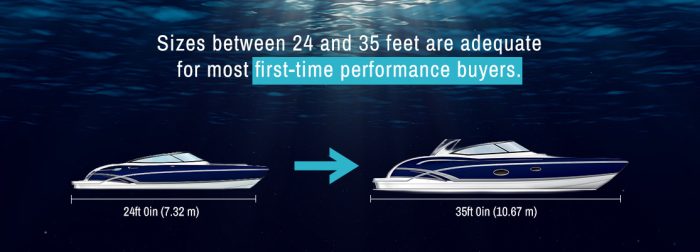
Sizes between 24 and 35 feet are adequate for most first-time performance buyers. However, specific variables may nudge you toward one end or the other.
- Boating location: Coastal and open-water use rewards length. Lakes and protected waterways are more forgiving of a smaller hull.
- Crew size: This factor is easy to underestimate, but hosting four passengers and eight passengers on the same boat can feel like two entirely different experiences.
- Time on the water: If you plan to spend the night on your boat, cabin comfort deserves just as much attention as deck layout.
- Beam width: Wider hulls sit stably at anchor, especially with a group on board.
Ask a knowledgeable dealer to help you match these priorities to specific models before you start narrowing options on your own.
Budget Planning Beyond the Purchase Price
The purchase price is only the starting point. Boat size directly affects fuel consumption and storage costs, and first-time buyers who don’t account for these recurring expenses often feel the squeeze in their first season.
Insurance, fuel, maintenance and storage are four ongoing costs that must be part of your budget from Day 1. Additionally, annual engine service, drive maintenance, fluid changes and winterization in colder climates are nonnegotiable if you want the boat to hold its value. Storage runs from a few hundred dollars a month for dry stack to significantly more for a marina slip in a high-demand area. Trailering at home costs less but requires a tow vehicle and extra effort each time you launch.
Before you commit to a number, use an online boat builder tool to see what a boat configured with all your bells and whistles would cost. That price, combined with a realistic estimate of annual operational expenses, gives you a much more accurate picture of total ownership than the base sticker.
Financing and Insurance Essentials
Most people use financing to buy performance boats, and the process feels more like a mortgage than a car loan. Down payments typically fall between 10% to 20%. Loan terms vary by the boat’s value and age, and lenders are much more willing to finance boats within roughly 15 model years. Securing a loan on a significantly older vessel is harder and depends heavily on the lender. If you still owe on a current boat, you will generally need to sell or pay it off as a prerequisite for applying for a new loan.
Secure a marine-specific insurance policy before the boat touches water to protect your investment and your on-water liability. Work with a marine insurance specialist instead of adding the boat to your homeowner’s policy. The coverage differences are substantial, and the specialist will walk you through options that match how and where you plan to use the boat.
Buying From a Dealer vs. a Private Seller
Purchasing a performance powerboat from a dealer or a private seller depends on how much protection and support you want after the sale. Generally, reputable dealers reduce the number of unknowns for first-time buyers.
Going through a dealer will give you a manufacturer warranty, in-house repair services and ongoing support after the sale. If something comes up in the first season, you have a relationship and a service department behind you. In contrast, with a private seller, you are largely on your own once the transaction closes.
Established builders back the dealer route further with brand-level coverage. For example, at Formula Boats, our Formula Guard limited warranty coverage applies to five years on most parts, accessories and drivetrain components, factory technical assistance, a network of authorized service providers and a complimentary five-year sea tow membership. That robust post-sale infrastructure does not exist in a private transaction.
The price difference between purchasing through a dealer and a private seller is often negligible once you account for warranty, reconditioning and the time spent managing the process yourself.
Pre-Purchase Checklist
A performance powerboat is a significant investment, and a little bit of preparation goes a long way. Use these steps to evaluate the boat, confirm safety and compliance and get ready for delivery day.
- Get on the water first: A sea trial is imperative. Run the boat at idle, at cruise and at wide-open throttle. Take turns, pay attention to how the hull handles chop and try docking if the dealer allows it. Invite the people who will usually accompany you on your outings. Two-passenger and six-passenger boats handle differently enough that it’s worth a trial before you sign.
- Check for NMMA certification: Look for a plate near the helm that confirms the boat meets nationally recognized standards for safety, construction and electrical systems. It only takes a moment to verify this crucial information.
- Have a storage plan before delivery day: Decide where you’ll keep the boat — a marina slip, dry stack or your garage. Marina spots fill quickly as the season approaches. If towing, confirm your vehicle can handle the load.
- Handle insurance and registration: Work with a marine insurance specialist to activate your policy before putting your boat into the water. Secure registration and titling through your dealer or state boating authority so everything is in place when it’s time for your first adventure on the water.
A Family Legacy of Performance and Quality
The Porter family has owned and managed Formula Boats since 1976, building every boat at our Decatur, Indiana, headquarters. Today, we are a three-generation business, and that continuity shines through in how we support our boats long after the sale.
Explore our model lineup online, use our builder tool to configure a boat with your ideal features or connect with a dealer near you for a personal walk-through.